AI Model Training for University Examinations
AI Model Training for University Examinations: From GB10 to Production
Reduce faculty workload by 40%, improve grading consistency, and enable secure, local AI-assisted assessment management across your institution—without cloud dependencies.
By
Yogesh Huja
Founder & CEO, Gignaati AI
Published
February 2026
Read Time
12 minutes
The Challenge: Assessment at Scale
International research indicates that 30–50% of academic working time is spent on non-teaching activities—primarily exam preparation, grading, and result processing. For Indian universities managing thousands of students across multiple semesters, this burden becomes unsustainable.
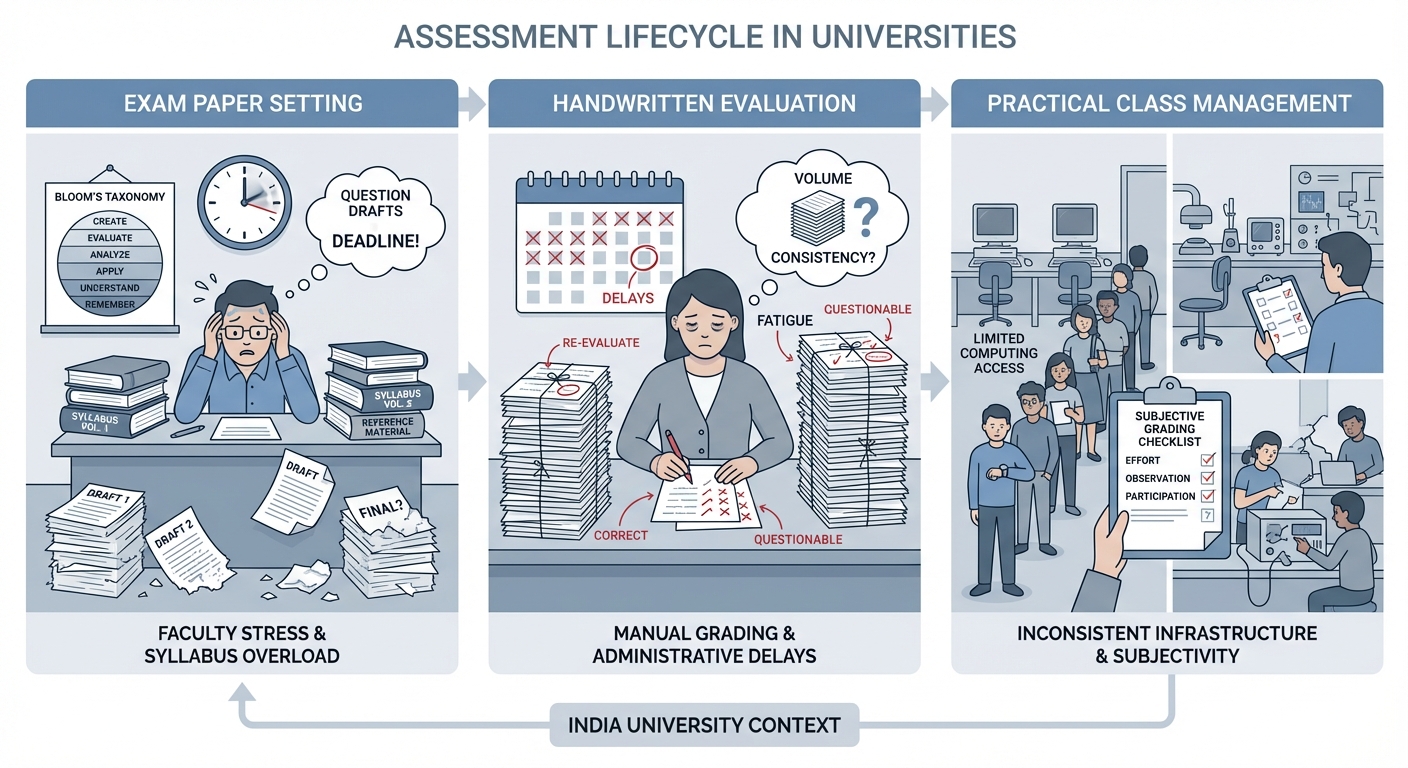
Exam Paper Setting
Manual creation of balanced question papers requires alignment with syllabus, difficulty levels, and learning outcomes—often under tight timelines.
Handwritten Evaluation
Descriptive answers demand sustained concentration. Repetitive checking at scale leads to delays, inconsistencies, and increased re-evaluation workload.
Practical Management
Practical assessments are limited by uneven lab infrastructure, restricted compute access, and subjective evaluation methods across colleges.
The Solution: AI-Assisted Assessment Workflows
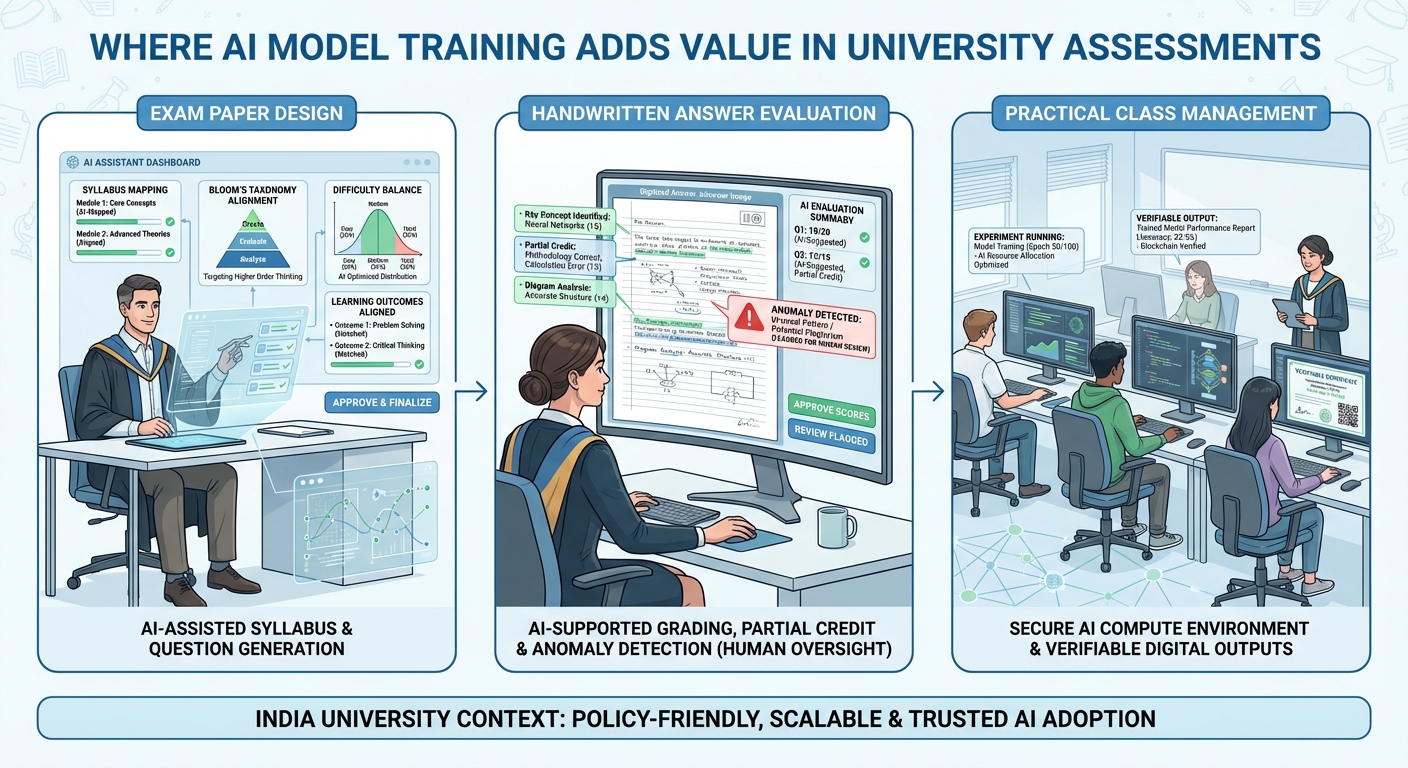
AI models trained on institution-specific data—past question papers, evaluated scripts, rubrics, and practical records—can assist universities across the entire assessment cycle. This is not automation; it is augmentation with human oversight.
Exam Paper Design
AI-assisted syllabus mapping, Bloom's taxonomy alignment, and difficulty balancing reduce faculty time by 40% while maintaining academic rigor.
Handwritten Evaluation
OCR + trained models recognize partial understanding, flag anomalies, and suggest scores—with faculty maintaining final authority and review.
Practical Management
Secure, local AI compute access allows students to experiment with real tools while maintaining institutional control and data privacy.
Getting Started: Implement on GB10
Phase 1: Data Preparation & Model Selection
Prepare institution-specific training data and select appropriate models for your use case.
Phase 2: Fine-Tuning on GB10
Train models on your institution's assessment data using local compute.
Phase 3: Deployment & Integration
Deploy trained models as microservices on GB10 and integrate with your assessment workflows.
Scaling to Production: Dell AI Factory
Once your GB10 pilot demonstrates value, scale to Dell AI Factory for university-grade production deployment. This transition enables multi-campus orchestration, enterprise SLAs, and institutional governance.
GB10 (Pilot Phase)
- ✓Single-node deployment
- ✓100% local data residency
- ✓Faculty-level access control
- ✓Proof-of-concept & validation
- ✓Cost: ₹50–100K (one-time)
Dell AI Factory (Production)
- ✓Multi-campus orchestration
- ✓99.9% uptime SLA
- ✓Role-based access & audit logs
- ✓Institutional governance & compliance
- ✓Cost: ₹5–10L annually
Migration Checklist
- 1.Model Export: Export fine-tuned models from GB10 in standard formats (ONNX, TorchScript).
- 2.Data Migration: Transfer training data, evaluation metrics, and faculty feedback to Dell AI Factory.
- 3.API Compatibility: Ensure microservices deployed on GB10 work seamlessly on Dell AI Factory infrastructure.
- 4.Governance Setup: Configure role-based access, audit trails, and compliance reporting for institutional oversight.
- 5.Performance Tuning: Optimize model inference latency and throughput for multi-campus deployment.
Key Takeaway
"AI should free humans from repetitive tasks so they can focus on creativity, judgment, and empathy."
— Sundar Pichai
AI model training in examinations and practical management is not about automation—it is about reducing academic burden, improving fairness, and strengthening transparency, while allowing teachers to focus on the human aspects of education that matter most.
Ready to Transform Your Assessment Workflows?
Start your pilot on GB10 today and experience how local AI can reduce faculty workload while improving assessment quality and fairness.
About the Author
Yogesh Huja is a serial entrepreneur and AI architect with over 25 years of industry experience in building and scaling technology-led solutions. He founded Swaran Soft, a Gurgaon-based software company that continues to solve complex software and digital transformation challenges for enterprises globally.
Drawing from this deep industry foundation, Yogesh is now building Gignaati, an AI Academy and Agentic AI platform with a mission to upskill 10 million learners in practical AI skills and build a globally relevant, job-ready AI workforce.
He is also a two-time author, including the best-selling book Invisible Enterprises, which examines real-world AI adoption and the growing role of AI agents—always with a focus on fairness, transparency, and human oversight.
Related Articles
CES 2026 POV: AI Infrastructure Transformation
Explore how AI is shifting from software to infrastructure, and what it means for enterprises.
Read more →Building AI Agents on GB10: A Practical Guide
Step-by-step guide to building and deploying AI agents on local infrastructure.
Coming soonRelated Articles
Ready to Deploy Your GB10 AI Lab?
Book a 15-minute discovery call to discuss your AI infrastructure needs and get a customized deployment plan.